Leave Your Message

2026 Best Alloy Steel Casting Parts Manufacturers?

Choosing the best Alloy Steel Casting Parts manufacturers in 2026 takes more than comparing polished websites. Buyers need evidence of process control, material knowledge, and dependable delivery. Alloy steel grades respond differently to heat treatment, section thickness, and cooling rates. A supplier’s experience with one component may not transfer neatly to another.

Casting specialist John Campbell is widely associated with the principle, “The quality of a casting is determined by the quality of the liquid metal.” That idea makes foundry controls worth examining, not just finished-part photos. Ask how each manufacturer verifies melt chemistry, manages pouring temperatures, and checks for internal defects. Request relevant inspection records, sample reports, and details about heat-treatment capability. Small details matter. A rough surface near a critical bore, for example, can create extra machining work or expose a process weakness.

This guide compares manufacturers through practical criteria, including alloy range, tooling support, quality systems, production capacity, and communication. It also considers whether suppliers can explain trade-offs clearly, rather than promising every outcome. A ranking is useful, but never complete. Requirements differ by part geometry, service conditions, and order volume, and public information may not reveal day-to-day consistency. Treat the shortlist as a starting point; verify claims with technical discussions and, where practical, a sample evaluation.
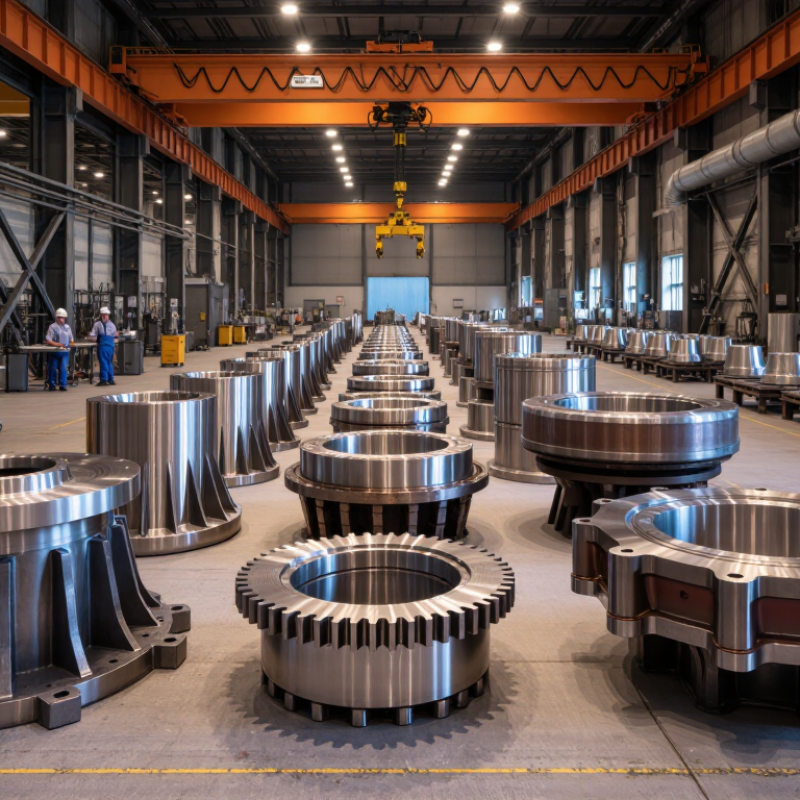
2026 Best Alloy Steel Casting Parts Manufacturers?

What Are Alloy Steel Casting Parts and Where Are They Used?

Alloy steel casting parts are components made by pouring molten alloy steel into shaped molds, then cleaning and finishing the solid casting. Chromium, manganese, nickel, or molybdenum can improve hardness, toughness, or resistance to wear, depending on the grade and heat treatment. These parts suit demanding service, but no single alloy performs best in every environment.

Common examples include crusher jaws and liners in mining, pump housings and valve bodies in processing plants, and heavy-duty components for construction and rail equipment. The World Steel Association’s April 2024 Short Range Outlook projected global steel demand at 1.793 billion tonnes in 2024. That figure describes the broad steel market, not casting output. It offers context, not a direct measure of alloy casting demand. In practice, load, impact, temperature, corrosion, and repair access matter as much as the part’s shape. A drawing alone rarely settles the material choice; prototypes or service feedback may reveal issues the design missed.

Tips: Share operating temperatures, impact loads, and wear conditions with the foundry. Ask how the alloy and heat treatment were verified. Small details matter. A casting that looks sound can still need adjustment after real-world use.

How Are Alloy Steel Casting Manufacturers Evaluated in 2026?

How should alloy steel casting manufacturers be evaluated in 2026? Start with evidence from the parts themselves, not a polished brochure. Ask for heat-by-heat chemistry records, tensile and impact results, and documented non-destructive testing. Check whether inspection covers the casting’s critical sections, such as thick hubs, thin ribs, and machined bores. A supplier should explain how it controls pouring temperature, heat treatment, and defects—and show what happens when a result falls outside limits. Small details matter.

Production capacity also needs context. World Steel Association data put global crude steel output at 1,882.6 million tonnes in 2024, but that figure does not measure casting quality. It does show the scale of the wider material supply chain.

The International Energy Agency reports that iron and steel account for about 8% of global final energy demand and 7% of energy-system emissions. Ask foundries for measured energy or scrap data, while avoiding claims that one metric proves environmental performance. Review sample-to-production consistency, traceability, delivery history, and corrective-action records. Visit the process, if possible. No scorecard captures every failure mode; even a strong audit can miss a weak handoff between melting and heat treatment.

Which Manufacturing Capabilities Distinguish Leading Suppliers?

Choosing a capable alloy steel casting supplier in 2026 means looking beyond equipment lists. Strong manufacturers connect part design, tooling, melting, heat treatment, and machining into one controlled process. They can review wall thickness, draft angles, and feeding paths before a pattern is made. Casting simulation can flag shrinkage risks around thick hubs or ribs, though a simulation cannot replace shop-floor validation.

Ask how the supplier controls alloy chemistry between heats and records furnace temperature, pouring conditions, and heat-treatment cycles. Request sample inspection records showing dimensional checks and suitable non-destructive testing, such as ultrasonic or magnetic particle inspection. For machined parts, confirm datum strategy and machining allowances early. A polished brochure is not evidence. Clear, part-specific records are more useful. No single capability checklist fits every component; demanding every service in-house may add cost without improving quality.

Tips: Send a drawing, annual volume, service conditions, and critical dimensions for review. Ask for a sample control plan and a realistic production timeline. Compare responses carefully. If a supplier cannot explain how it handles a casting defect, pause before approving the order.

2026 Best Alloy Steel Casting Parts Manufacturers? Which Manufacturing Capabilities Distinguish Leading Suppliers?

ASTM A217/A217M Alloy Steel Casting Grades: Minimum Specified Strength at Room Temperature

WC6 and WC9 are chromium-molybdenum alloy steel casting grades specified in ASTM A217/A217M. The chart shows their minimum tensile and yield strengths in ksi. Suppliers should be able to demonstrate grade control through material traceability, heat treatment, and mechanical testing; actual requirements depend on the applicable standard edition and purchase specification.

How Do Major Alloy Steel Casting Manufacturers Compare?

Comparing major alloy steel casting manufacturers requires more than checking quoted prices. Grand View Research valued the global steel casting market at about US$27.8 billion in 2023, reflecting demand across heavy equipment, energy, and transport. The figure covers steel castings broadly, not alloy grades alone. It signals a large market, not a ranking of supplier quality.

A useful comparison starts with the part itself: alloy chemistry, section thickness, heat treatment, and inspection requirements. Ask for material test certificates, mechanical test results, and non-destructive testing records tied to each production lot. The World Foundry Organization’s census reports global casting output above 100 million tonnes annually. That scale makes process control essential, but total output does not prove a foundry can produce your specific geometry reliably.

Compare sample approval, defect rates, tooling ownership, and delivery performance using the same part drawing and acceptance criteria. A polished sample can hide variation between furnace batches. Ask how the manufacturer controls melt composition and prevents distortion during heat treatment. Then review a recent inspection report, not just a capability brochure. Price still matters. Yet a lower quote may exclude testing, machining, or corrective work; clarify those items before judging value. That comparison is not perfect, especially when suppliers use different reporting methods.

2026 Best Alloy Steel Casting Parts Manufacturers? - How Do Major Alloy Steel Casting Manufacturers Compare?

Supplier-neutral comparison of common ASTM alloy-steel casting grades and the evidence buyers can use to compare manufacturers. The chemistry ranges below are representative specification ranges; confirm the applicable ASTM edition, grade, product requirements, and purchase-order details before ordering. No manufacturer-specific performance or pricing is implied.

Comparison dimension ASTM A217 Grade WC6 ASTM A217 Grade WC9 ASTM A217 Grade C5 What to compare across manufacturers
Specification scope Alloy-steel castings for pressure-containing parts designed for elevated-temperature service. Alloy-steel castings for pressure-containing parts designed for elevated-temperature service. Alloy-steel castings for pressure-containing parts designed for elevated-temperature service. Confirm the supplier can manufacture and certify the exact ASTM grade and any additional project, code, or customer requirements.
Principal alloying elements Chromium and molybdenum; commonly described as approximately 1¼Cr–½Mo steel. Chromium and molybdenum; commonly described as approximately 2¼Cr–1Mo steel. Higher chromium with molybdenum; commonly described as approximately 5Cr–½Mo steel. Request the material test report and verify the heat analysis against the specified grade rather than relying on a grade nickname.
Representative chemistry ranges Chromium: 1.00–1.50%; molybdenum: 0.44–0.65%. Chromium: 2.00–2.75%; molybdenum: 0.90–1.20%. Chromium: 4.00–6.00%; molybdenum: 0.44–0.65%. Ranges are weight percentages and are representative; confirm all required elements, limits, and permitted variations in the current specification.
Typical selection context Used for pressure-containing cast components in elevated-temperature service where the specified WC6 properties are suitable. Considered for elevated-temperature pressure applications requiring the WC9 grade’s specified alloy composition and mechanical properties. Considered for pressure-containing components where the specified higher-chromium C5 grade is required. Compare the application’s design temperature, pressure, corrosion conditions, design code, and engineering approval; a grade alone does not establish suitability.
Heat treatment Heat treatment is required as specified for the grade and applicable standard; the exact route depends on the specification and casting requirements. Heat treatment is required as specified for the grade and applicable standard; the exact route depends on the specification and casting requirements. Heat treatment is required as specified for the grade and applicable standard; the exact route depends on the specification and casting requirements. Ask for the documented heat-treatment procedure, furnace records, traceability to the casting, and test results required by the purchase order.
Mechanical properties Specified tensile and hardness requirements depend on the applicable grade requirements and test conditions. Specified tensile and hardness requirements depend on the applicable grade requirements and test conditions. Specified tensile and hardness requirements depend on the applicable grade requirements and test conditions. Compare certified results with the exact standard requirements, test-piece location, specimen type, and any supplementary requirements.
Inspection and testing Testing and inspection depend on the governing specification, order, and service requirements. Testing and inspection depend on the governing specification, order, and service requirements. Testing and inspection depend on the governing specification, order, and service requirements. Specify required visual, dimensional, pressure, and nondestructive examinations (such as radiographic, magnetic-particle, or liquid-penetrant testing) and acceptance criteria in advance.
Casting capability to assess Grade selection does not by itself indicate casting size limits, achievable tolerances, defect levels, or production capacity. Request relevant sample inspection reports, dimensional capability data, process controls, and evidence of experience with comparable part geometry and section thickness.
Traceability and documentation Material identity and compliance should be supported by records for the supplied castings. Compare heat-to-part traceability, material test reports, heat-treatment records, inspection reports, nonconformance controls, and document retention practices.
Best comparison approach Select the grade through engineering review against the design conditions and applicable codes; do not substitute grades based only on similar alloy content. Evaluate each manufacturer against the same drawing, specification revision, inspection plan, quantity, delivery terms, and documentation requirements.

How Should Buyers Choose a Manufacturer for Their Application?

Choosing an alloy steel casting manufacturer starts with the part’s working conditions. Define the load, operating temperature, exposure to abrasion or corrosion, and expected service life. A valve body in a hot process line needs different priorities from a wear plate in a crushing machine. Share drawings, material requirements, and expected production volume before comparing quotations. Low price alone can hide extra machining, longer lead times, or unsuitable heat treatment.

Ask how the manufacturer controls each stage, from pattern preparation and melting to heat treatment and final inspection. Request material certificates, dimensional reports, and relevant test results for a comparable part. If your design is still changing, discuss prototype quantities and tooling ownership early. A factory visit can help you see how castings are identified, inspected, and protected from damage. A polished brochure is not proof. Clear answers matter more. Still, no checklist removes every production risk; leave room for review after the first sample.

Tips: Send one critical feature for close evaluation, such as a mounting bore or wall thickness. Agree on inspection limits before production. Ask who will contact you if a test result falls outside specification. Record changes in writing, even small ones.